


The Edifice
Installation / Performance Structure
Echo Contemporary, Atlanta, Georgia, United States
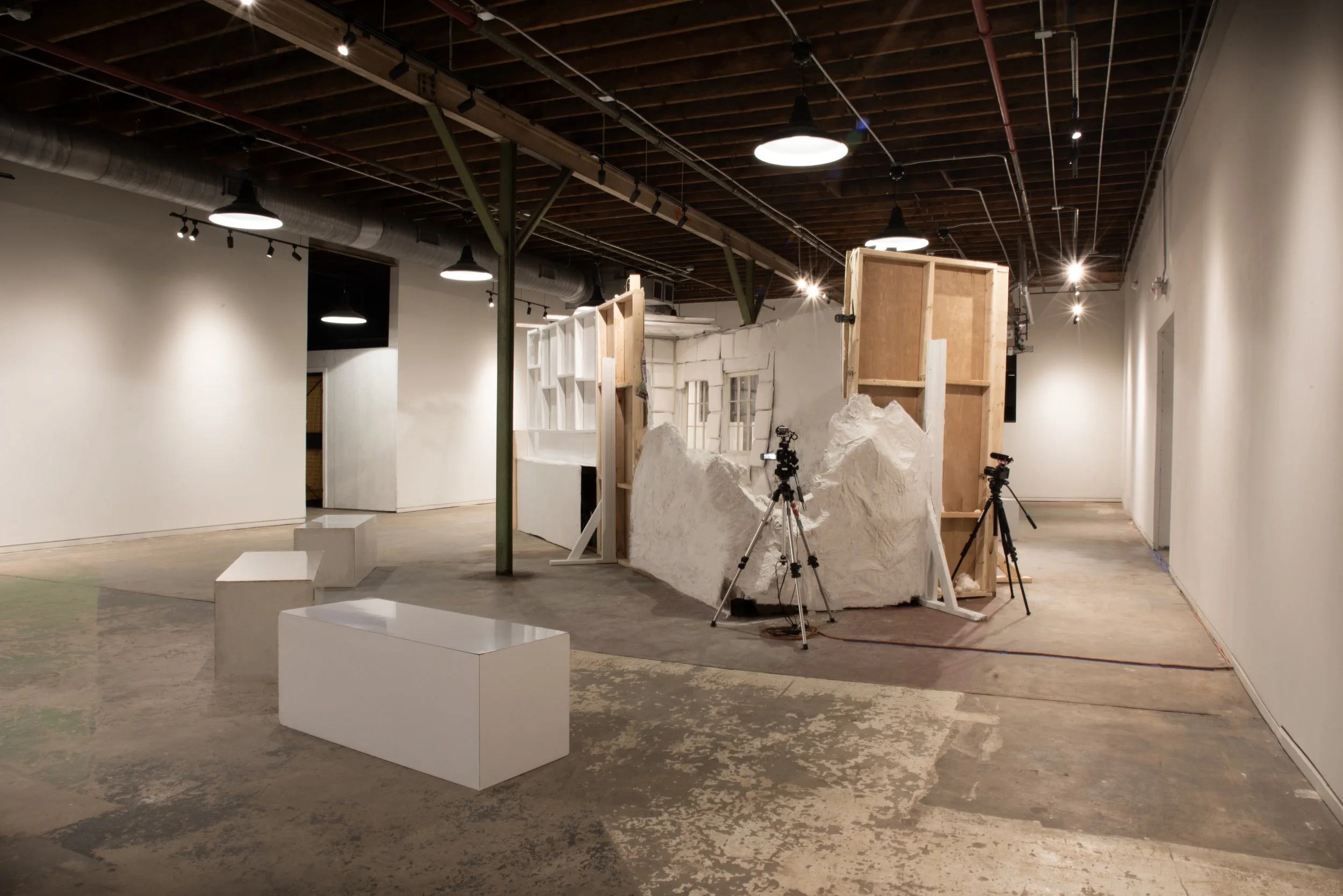
The Edifice is a constructed environment that serves as both sculpture and performance space within Three Tries. It is a replica of the tomb of Jesus Christ, merged with the room where the artist was held during institutionalization, collapsing religious narrative and lived experience into a single structure.
The exterior draws from the Church of the Holy Sepulchre and the Garden Tomb. The front echoes the Garden Tomb with its cave-like opening and roll-away stone, including a small viewing aperture referencing Mary Magdalene looking inside. The back reflects the more constructed architecture of the Holy Sepulchre, pointing to how sacred spaces are shaped and staged.
The inside of the structure is divided into two connected chambers. The anti-burial room acts as a threshold, built from simple materials that mimic stone while revealing their construction. The burial room is a padded enclosure based on the artist’s experience of solitary confinement, with a mirrored ceiling that reflects the body and intensifies the sense of containment. Surveillance cameras record both the interior and those who look inside.
Objects throughout the space read as both altar and archive, arranged with intention while also holding the weight of documentation. On a pedestal sit three bottles of holy water, a loaf of bread, and Israeli red wine, alongside the medication the artist relies on following their diagnosis. Nearby are three books, Freud’s Interpretation of Dreams, a Bible from the artist’s childhood church, and a revised version of the journal kept during institutionalization. Adjacent to this, another pedestal holds a crate of art supplies, topped with A Book for Self-Resurrection. Together, these elements bring religion, psychology, and lived experience into close proximity, allowing these different systems of understanding to overlap, conflict, and inform one another.
The edifice is the site of Three Tries: The End performance. Within this space, the artist attempts to separate the id from the ego and superego, using the structure as a container for that internal conflict.
At its core, The Edifice is about containment and transformation, revealing how systems of belief and control are built and internalized. It holds the body within these structures, showing how they shape perception, behavior, and self-understanding over time. At the same time, it begins to expose their construction, making visible what once felt fixed or unquestionable. In doing so, the work opens up the possibility of confronting, resisting, and reworking those systems from within.
Photography by Audrey White.